
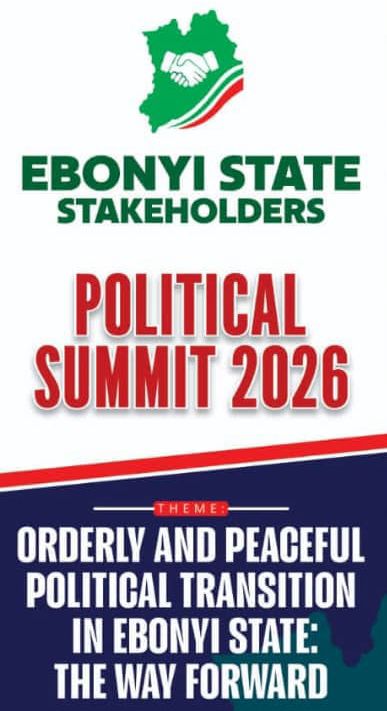
The Ebonyi State Political Stakeholders Summit 2026, will go down as an historical landmark, just as the forum is expected to offer an opportunity for a critical assessment of the past, and present political actors in the state.
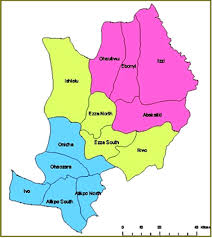
Ebonyi, as a state, stands on a geo-political tripod of the North, Central, and South Senatorial districts.
Within these three geo-political divides are thirteen local government areas, covering several communities, electoral wards and other smaller political units.
Prior to the creation of the state on October 1,1996, by Nigeria’s former dictator, late Gen. Sani Abacha, the Ebonyi North, and Central Zones formed the old Abakaliki, Ishielu, and Izzi Local Government Areas of the old Enugu State.
The present Southern Senatorial District of Ebonyi State was also an integral part of the old Abia State, comprising five out of the thirteen local government areas of the state.
Further creations grouped the two political divisions as Abakaliki, and Afikpo blocs of the present Ebonyi State, with the two groups having little or no clear variations in their cultural, religious, and political affinities.
It is on record that some notable figures from the two blocs, actually led the struggle for the creation of Ebonyi State. Prominent among the people were; Ezeogo Dr. Francis Akanu Ibiam, Dr. Offia Nwali, Chief Martin Nwanchor Elechi, Onyiba Aja Nwachukwu, Ezeogo S.O. Mgbada, and Onyiba Uneke Enyi.
Others include Chief Tony Iferenta, Chief Francis Oji, Omezue Anthony Ekoh, Senator Andrew Nwankwo, Chief Nweke Anyigor, Dr. Gabby Idam, Chief Chris Nankwo, and Chief Okeagu Ogadah.
The rest include Dr. Itcha Ituma, Dr. Agom Eze, Chief Polycarp Nwite, Elder Anyim Ude, Chief Ogbonnaya Aja Nwachukwu, Omezue Emmanuel Agboti, Ibe Nkama Ekuma, Chief David Ekwe Nwaze, Chief Felix Mgbada, Chief Henry Ude, and Chief Abia Onyike who was a leading force in the Youth Wing of the defunct Ebonyi State Movement. The list is inexhaustible.
It is also on record that the early days of the state’s creation was characterised by all sorts of unverified media speculations bordering on power sharing formula, political appointments and all that.
At a stage, it was even said that the founding fathers of the young state had earlier signed a pact tagged _’Ebonyi Charter Of Equity.’
This was, as rumour has it, anchored on the principles of justice, equity, and fairness, and which bordered more on rotation of the governorship position of the state among the three component zones of North, Central, and South.
A retired Captain in the Nigerian Navy, Walter Feghabo was first deployed by the military authorities as the Military Administrator of the young Ebonyi State.
The second was a Police Commissioner, Simeon Oduoye, who took over from Feghabo, when the military was actually winding up.
When the military finally exited political power in 1999, a former Commissioner for Education in Feghabo’s administration, Dr. Sam Ominyi Egwu, who is from the Northern Senatorial Zone of Ebonyi, became the first democratically elected governor of the state on the platform of the Peoples Democratic Party (PDP).
Egwu, who assumed office at a time the state was still battling to do away with the vestiges of military administrations, could not do enough in giving hope to the people.
He only left a mark in the education sector, by offering foreign scholarships to some post graduate students of Ebonyi origin, established a permanent site for the state university, while he left the rest for his predecessors.
Even with his popular slogan, _‘Ebonyi Standard Always The Best’_ Egwu’s administration did not go beyond these areas. He merely
embarked on the painting of some structures already put in place, by his military predecessors.
In truth, his eight years reign seemed an eye opener to upcoming generation of Ebonyi politicians mainly angling to take their destinies in their own hands, even when the state was still struggling with some sort of experiments in the practice of partisan politics.
Years back at the Abakaliki Township Stadium, venue of an historic governorship primary election of the Peoples Democratic Party (PDP), Senator Julius Ali Ucha, and Nigeria’s fomer Ambassador to Greece, Franklin Nchita Ogbuewu were openly caught in an epic battle, while a visibly reluctant Chief Martin Elechi merely played the spectator’s role.
It was obvious that what later played out in the end of the exercise, left no sweet songs on the lips of Ucha’s army of supporters who thronged the stadium, to cheer their own master, _‘Ucha My Man’_ to victory in that keenly contested governorship election primary.
Apparently less bothered Elechi became PDP’s
flag bearer and later, the second Executive Governor of Ebonyi State.
Opinion polls revealed that Chief Elechi who came from Ebonyi Central Senatorial Zone, was never prepared for such a heavy task, especially at his old age.
In keeping with the oral doctrine of _‘Ebonyi Charter of Equity’_ Elechi who is from Ebonyi Central, was said to have been preferred to Ucha who is an Ezza man, also from the same Central Senatorial Zone, because of the numerical advantage of the Ezza people.
Though the elder statesman seemed not prepared for the task, when he got there he proved himself a child of destiny through his landmark achievements.
Elechi’s first tenure in office witnessed massive infrastructural development in Ebonyi State, with his signature project of nineteen unity bridges that connected communities within the riverine areas of the state to their neighbors
During his second tenure, he also increased the number of these unity bridges to twenty three. These bridges have continued to play a strategic role in boosting food supply to the cities from the largely agrarian rural communities of the state.
The Ochudo City project which though is another monumental achievement of Elechi’s eight years of impactful administration in Ebonyi State, posed a traumatic experience to the Agbaja Unuphu people.
The infant stages of the project suffered stiff opposition from the host community, Agbaja Unuphu, as the people saw it as a ploy by Elechi’s government, to evict them from their homes.
An indigene of the community who chose to remain anonymous, told our correspondent that he personally thought that the former governor was only using his powers, to displace the Agbaja Unuphu natives and deprive them of the right to their inheritance.
His said, “I was personally of the opinion that governor Elechi was merely using his executive radicality to displace our people. I never imagined that Ochudo City was going to be such a legacy project.”
The third executive governor of Ebonyi State, Engr. David Nweze Umahi came from the Southern Senatorial District of the state. He rose from the position of chairman of the People’s Democratic Party (PDP) in the state to deputy governor and later the governor.
As governor, Umahi operated on a very familiar terrain and so exhibited a high level of maturity, competence, discipline and prudence in the management of public affairs.
His administration came on board with a robust blueprint for infrastructural and manpower development, cutting across every segment of the state’s economy
The Dr. Chuba Okadigbo Airport in Onueke, Muhammadu Buhari Glass Tunnel, and the ever busy Christian Ecumenical Center, both located in the heart of Abakaliki capital city are a few out of the numerous projects executed by Umahi’s administration.
Having completed the circle of rotational governorship, a former Speaker of the Ebonyi State House of Assembly, Rt. Hon. Francis Ogbonna Nwifuru who hails from the Ebonyi North Zone, was in the second turn elected as the fourth executive governor of the state.
He also came in with policies and programmes that bother a lot on a holistic approach to economic rejuvenation, human capital development, and industrial growth.
Be that as it may, Governor Nwifuru’s administration has made tremendous impacts on the lives of the teeming Ebonyi populace.
Just as his first tenure in office gradually winds up, Nwifuru has already made a mark in the areas of human capital development, transportation, education, industrial and infrastructural development.
He had specifically left an indelible foot print in the Aviation sector following the establishment of a university of Aeronautic Engineering, for the provision of manpower needs to tackle possible aeronautic challenges.
The ICT university in Oferekpe Agbaja, is another monumental achievement of the present administration, led by governor Nwifuru.
The establishment of the ICT university came at an era of digital economy, just as the world itself has turned a global village.
It is again another election period. So, as the time draws near, the electorate should be wise enough not to vote the wrong persons into power.
The people should be careful enough to take cognisance of the fact that power resides with them: that their vote is their power, and that their future could be made or marred by their votes.
In the past, we have had so many unfulfilled promises from sugar-tongue politicians who have made public outings and even appeared in various fora to promise us heaven, here on earth without keeping a dime.
Therefore, the biggest task before any participant in the Ebonyi Political Stakeholders Summit is ensuring that governance brings contentment. It is also for conscience search.
This is because no amount of awareness, sensitisation or pre-election campaigns will make a change in the political belief systems of the people.
Apart from a candidate’s endorsement by his or her political party, the highest endorsement comes from the electorate. So, it is only a matter of the voting populace individually throwing their faces away from the greek gifts that normally dominate the political space only during election periods.
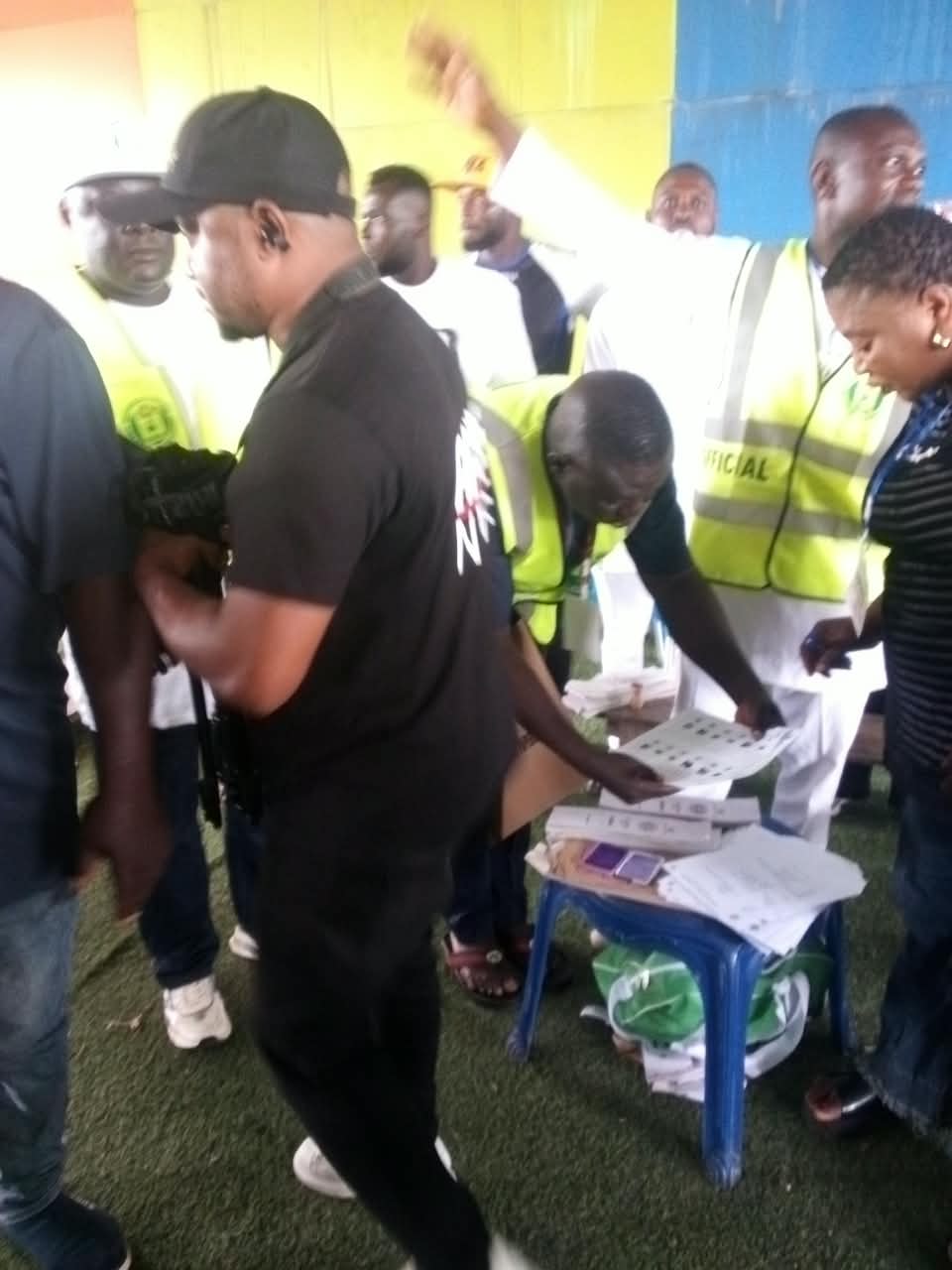
It should not also be expected that the forthcoming elections, be it presidential, governorship, State or even Assembly, will turn the entire scenario to a battle field.
Again the summit also has a duty to ensure that candidate and their various political parties, are duly advised to be guided in their conducts, especially at election venues.
There should be no hate speeches at election venues, no vote buying, no carrying of ballot boxes, no bullying of candidates and their supporters.














Leave a Reply