
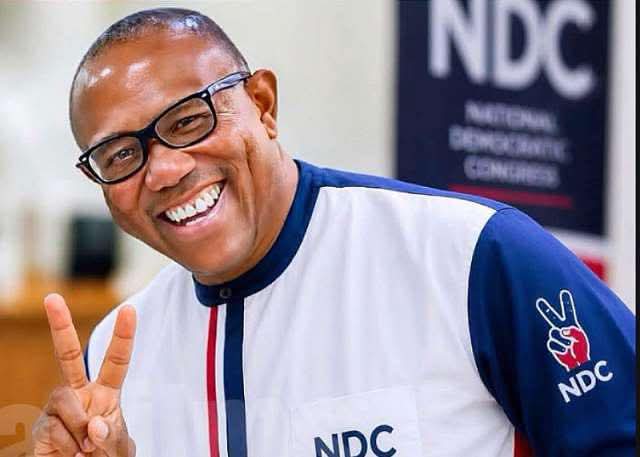
Presidential Candidate of the Nigeria Democratic Congress, NDC, Mr. Peter Obi, on Friday, kicked off his campaign for the 2027 general election with a promise to set an economic agenda that will put production, investment, enterprise
and human capital at the centre of leadership.
Obi, who spoke in Onitsha, Anambra State, said, if elected president, his administration would raise agricultural productivity by securing farming communities, expanding irrigation, improving rural roads and storage, and linking farmers to finance and markets.
“We will also strengthen manufacturing and agro-processing so Nigeria can export more finished goods and capture greater value from its resources,” the former Anambra State governor said.
Obi said his administration would create a business environment where entrepreneurs can invest, hire, and grow without unnecessary regulatory or infrastructure barriers.
“And we will manage public finances responsibly. Every naira should have a clear purpose, and major public investments should have measurable outcomes.
“The goal is not growth for its own sake, but an economy that produces more, employs more people, creates wealth, and improves living standards,” he said.
Restating his commitment to leading Nigeria from consumption to production, Obi said the country’s huge population of over 200 million provides an opportunity to it around.
“Nigeria, with a population now above two hundred million and projected to continue growing rapidly, has one of Africa’s largest domestic markets and labour forces.
“That is an opportunity we must seize to turn the future of our country around.
“Nigeria cannot import its way to prosperity. We will produce more of what we consume, process more of what we produce, and compete more effectively in global markets,” he insisted.
He said his administration would deploy experiences in public funds management, the private sector, and the civil service to turn the country’s population into productive human capital, natural resources into value-added industries, and domestic market into an engine for investment and enterprise.
“Agriculture, manufacturing, technology, construction, energy, creative industries, and services all have important roles to play.
“Nigeria does not lack opportunities; what it needs are the systems that enable its people to turn those opportunities into prosperity,” the NDC presidential candidate said.
Pointing out that no nation can prosper when its people cannot live, farm, travel, or do business safely, Obi said insecurity has displaced millions of Nigerians and continues to disrupt agriculture, education, trade, and investment in Nigeria.
He declared that response of his administration to insecurity in Nigeria would be comprehensive.
“We must improve intelligence gathering and coordination among security agencies, strengthen policing and border management, and make better use of technology.
“We must also support lawful community-based systems that identify threats early and enable effective responses.
“The imperative of decentralising security management, but with strong systems of coordination between the levels, is critical to our plans,” Obi said.
He added that the security policy must also address the conditions that make vulnerable young people susceptible to criminal recruitment.
The presidential hopeful said his successful private-sector experience, studies in institutions of repute on policy and business matters, and service as Governor of Anambra State have shaped his understanding of public leadership.
According to him government must manage resources responsibly, set clear priorities, and measure the outcomes of its decisions.
Obi maintained that public office is not a reward, but a responsibility to the people.
“In Anambra, I prioritised the foundations of long-term development: education, healthcare, infrastructure, fiscal discipline, and institutional capacity.
“I do not present that record as perfect, but as an experience from which Nigerians can draw their own conclusions.
“Senator Rabiu Musa Kwankwaso brings a different but complementary governing experience.
“As Governor of Kano State, he focused strongly on education, technical training, scholarships, infrastructure, and human-capital development.
“His administration’s investments in education and skills showed an understanding that the people are a state’s most important long-term resource.
“Our experiences are different, but our conclusion is the same: Nigeria must invest in its people and manage public resources with discipline,” Obi said.




Leave a Reply