
Emelayo Nwosu
Former President Olusegun Obasanjo has spoken out against the xenophobic attacks in South Africa, stating that the Apartheid regime would not have ended if Nigeria had not galvanized and led other African countries to fight against racial segregation that existed there for many years.
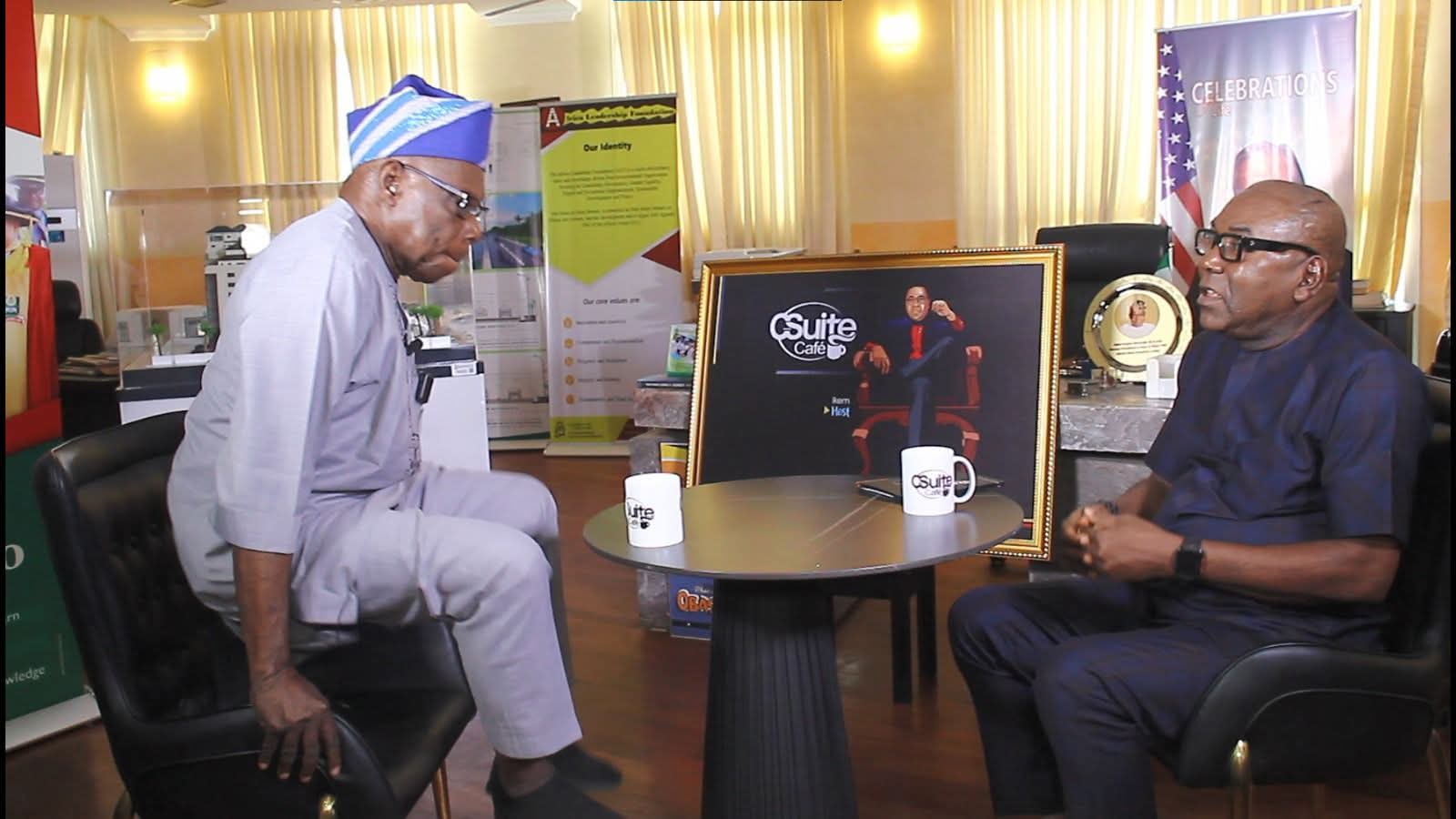
Obasanjo spoke in an exclusive interview with Ikem Okuhu on C-Suite Café (https://youtu.be/CTrlLMyd_xs?si=oJLfKy2enRi-dbN6.)
Obasanjo, who, as Nigeria’s military head of state from 1976 to 1979, played active part in the fight against white minority rule in the southern African country, said Nigeria moved to fight against the Apartheid system because of the belief that no black person should be seen as inferior to other races.
“We were not doing what we did in South Africa or in Southern Africa or decolonization anywhere for our personal gain or for our country. We did it for our race.
“I believe that no black man anywhere or black person anywhere should be regarded as inferior human being because of his colour,” he said.
Explaining that the principle that guided Nigeria in the struggle against Apartheid was that of enlightened self-interest, Obasanjo said Nigeria should be proud of what it did in liberating blacks from the stranglehold of white minority rule.
“If you like you can call it an enlightened self-interest of a kind, but not for us to say come and pay us back for what we did.
“And I for me—and I believe for Nigeria at that time and even now—we should be proud of what we did because without Nigeria, South Africa would not have got rid of Apartheid when it got rid of it. That’s true.
“And if you ask somebody like Andy Young who was the US Permanent Representative at the United Nations; he will tell you what he believes that Nigeria did.
“Of course, at a stage, we had to work with people like former President Jimmy Carter, James Callaghan in the Uk; with Nyerere; with Kaunda; with Samora Machel; and even with somebody like Olof Palme. We worked with these people and I think we got what we should get.”
Obasanjo blamed South African leaders for the attacks on African migrants, stressing that describing victims of xenophobia as illegal migrants doesn’t justify the mob attacks on them.
“I believe that South African leaders have not done what they should have done. Yes. There were criminals among the migrants, illegal migrants, criminals and things like that.
“But I do not believe that you use illegality to treat illegality, asking and encouraging ‘area boys and area girls’ to break into their houses and break into their shops,” he said.
The former president pointed out that the xenophobic attacks were neither in the interest of South AfricaI nor in the interest of the continent.
“I also believe that it is not in the best interest of South Africa itself or the best interest of Africa what has happened.
“One, what is the percentage of these migrants we are talking about. Two, some of them are also job creators. Some of them; I won’t say all of them.
“Three, how much, if you say they are taking your jobs, how much of your job are they taking over? And if you get these people out what will be the total outcome to South Africa”?
He acknowledged that it has been difficult for the African National Congress, ANC, to meet the expectations of black South Africans, but pointed out that the socio-economic challenges they face are not peculiar to their country.
“But I was trying to find out and people say to me that the ANC is having a political problem of meeting the expectations of the ordinary people. That may be true. If that is happening, the way they are going about it is not the right way.
“That may be happening not only in South Africa. It is happening everywhere. The expectation of the ordinary people is not being met in Nigeria. The expectation of the ordinary people is not being met in Kenya. The expectation of the ordinary people is not being met in almost all countries in Africa,” Obasanjo said.
He insisted that African integration and unity would not be achieved by using illegality to treat illegality.
Xenophobia: Without Nigeria South Africans Could Not Have Got Rid Of Apartheid—Obasanjo

Leave a Reply