
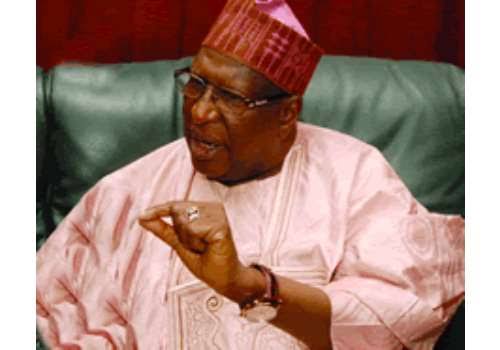
Former National Chairman of the Peoples Democratic Party, PDP, Alhaji Bamanga Tukur, is dead.
Tukur, who was also former governor of the old Gongola State and one of Nigeria’s prominent public servants and businessmen, died on Saturday at the age of 90.
His son, Awwal Bamanga Tukur, who is the Secretary to the Adamawa State Government, announced his death in a press release announced the death on behalf of the family.
“It is with profound sadness and total submission to the will of Almighty Allah that the family announces the passing of our beloved father and patriarch, Alhaji Bamanga Mohammed Tukur, who returned to his Creator today 12th September 2026,” Awwal said in the release.
Tukur’s death has brought to an end the life of one of Adamawa’s most prominent political figures and elder statesmen.
Tukur was born on September 15, 1935. He spent more than five decades working in Nigeria’s public service, politics, business and international economic affairs.
His career in public service began in the early years of independent Nigeria. He joined the Nigerian Ports Authority (NPA) and rose through the ranks before becoming its General Manager and Chief Executive, a position he held from 1975 to 1982.
His tenure at the NPA coincided with a period of major expansion in Nigeria’s maritime infrastructure.
He was also involved in international port organizations, serving as Vice Chairman of the International Association of Ports and Harbours and holding leadership positions in the International Cargo Handling Association.
Tukur subsequently moved into frontline politics and contested the governorship of the old Gongola State on the platform of the National Party of Nigeria, NPN in 1983.
He won the election and was sworn in as governor on October 1, 1983, but his administration lasted only about three months before the military coup of December 31, 1983, brought the Second Republic to an end.
After the coup, Tukur returned to business but remained deeply involved in Nigeria’s political affairs.
He was later appointed Minister of Industries under the military government of General Sani Abacha, serving in the 1990s.
He also emerged as a major figure in African business circles, serving as President of the African Business Roundtable and Chairman of the NEPAD Business Gro
Tukur was among the influential figures associated with the formation of the PDP ahead of the return to democratic rule in 1999
He later rose to the pinnacle of the party’s leadership when he was elected National Chairman of the PDP on March 24, 2012.
His tenure as PDP chairman was one of the most turbulent periods in the history of the then ruling party, as he faced fierce opposition from several governors and influential party leaders over his push for greater party supremacy.
Tukur also attempted to strengthen the party’s membership structure through reforms, including an electronic registration exercise, a move that critics and supporters interpreted as an effort to reduce the influence of state governors over the party.
He eventually resigned as PDP chairman in January 2014.
Former President Goodluck Jonathan subsequently appointed him Ambassador-at-Large in 2014, while Tukur had also served as Chairman of the Board of Directors of the Nigerian Railway Corporation.
Throughout his public career, Tukur maintained a reputation as a powerful political operator and businessman with extensive contacts across Nigeria and the African continent.
He was also conferred with the national honour of Commander of the Order of the Niger, CON.
Tukur formally announced his retirement from partisan politics in 2015, bringing an end to one of the longest political careers among Nigeria’s elder statesmen.
Former PDP Chairman, Alhaji Bamanga Tukur, Is Dead









Leave a Reply